

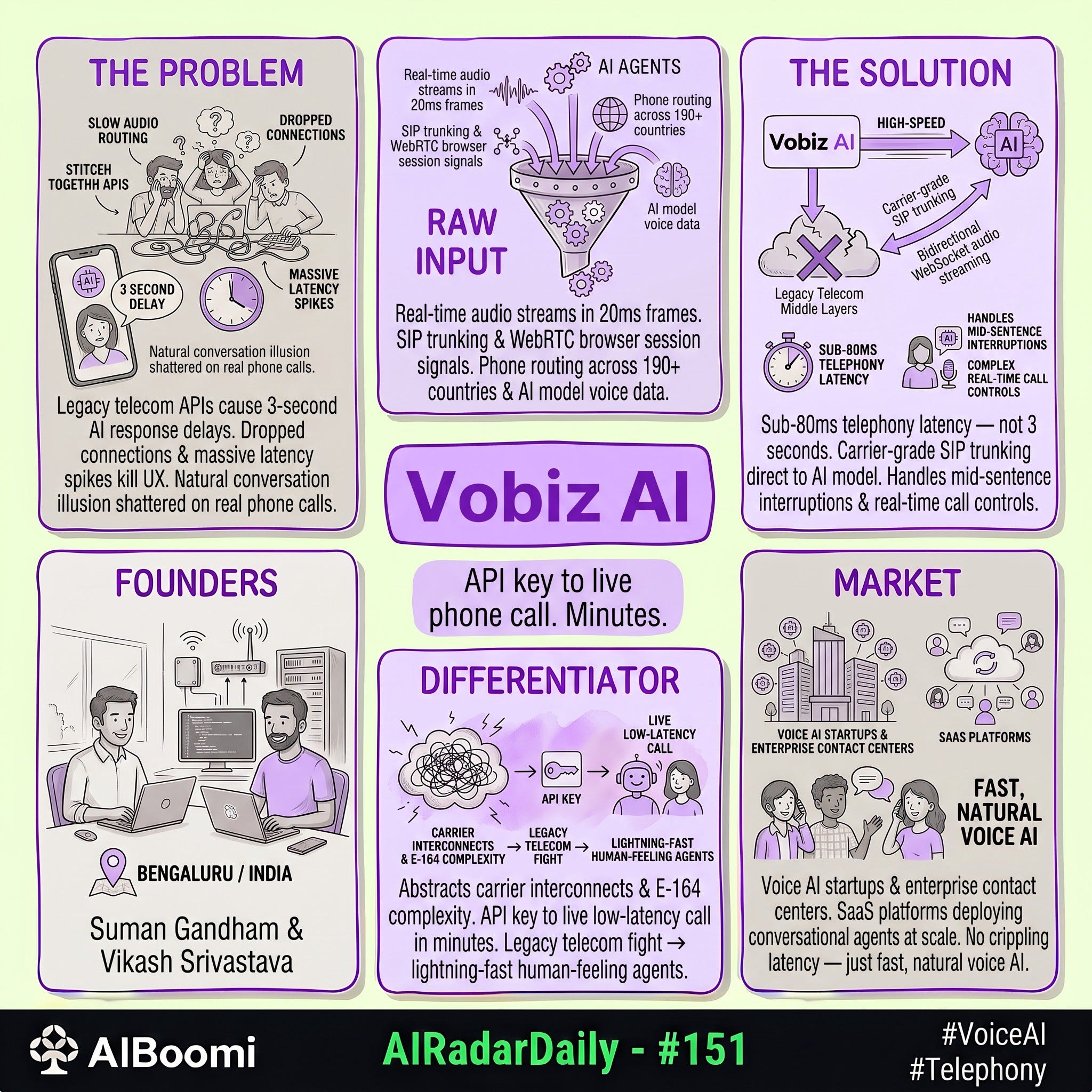
There is a quiet, frustrating reality inside every engineering team trying to build conversational voice agents today. Thanks to large language models and ultra-fast speech-to-text, creating an AI that sounds perfectly human in a browser is almost a solved problem. But the moment you try to connect that brilliant AI agent to an actual, real-world phone call, the entire experience falls apart. Teams are forced to stitch together legacy telecom APIs built a decade ago for traditional call centers, wrestling with agonizingly slow audio routing, dropped connections, and massive latency spikes. When an AI takes three seconds to respond because the underlying telephony infrastructure is too slow, the illusion of a natural conversation shatters entirely.
It takes builders with a profound grasp of global telecom infrastructure and the technical rigor to fundamentally rewire how machines interface with the public switched telephone network to solve this at the root. That is exactly what Suman Gandham and Vikash Srivastava are doing with Vobiz AI.
Founded in 2025, the Bengaluru-based team is building a deeply intelligent, AI-native telephony infrastructure platform where autonomous voice agents are treated as first-class citizens, not bolt-on afterthoughts.
Vobiz AI bypasses the bloated middle layers of traditional telecom, deploying carrier-grade SIP trunking and bidirectional WebSocket audio streaming directly to the AI model. Instead of relying on slow, batch-processed audio, they stream real-time audio in 20-millisecond frames, achieving sub-80ms telephony latency. Whether bridging WebRTC browser sessions to physical phone numbers across 190+ countries or executing complex, real-time call controls like mid-sentence interruptions, the platform handles the brutal, unglamorous physics of global voice routing.
The true moat here is uncompromising speed paired with global scale. Vobiz AI completely abstracts away the soul-crushing complexity of carrier interconnects, E-164 numbering, and regulatory compliance. It allows AI builders to go from a simple API key to a live, low-latency phone call in minutes. It shifts the paradigm from fighting legacy telecom infrastructure to deploying deterministic, lightning-fast voice agents that actually feel human.
The market? Voice AI startups, massive enterprise contact centers, and SaaS platforms who desperately need to deploy conversational agents at scale without the crippling latency of traditional telephony.
Seeing homegrown founders head-down, quietly architecting the heavy-duty connectivity layer that will power the next massive wave of human-computer interaction, is profoundly inspiring. They are giving AI builders their velocity and their agents a true voice back.
Let’s celebrate the builders.
✍️ Jay Ingle
#VoiceAI #Telephony #ProductNation