

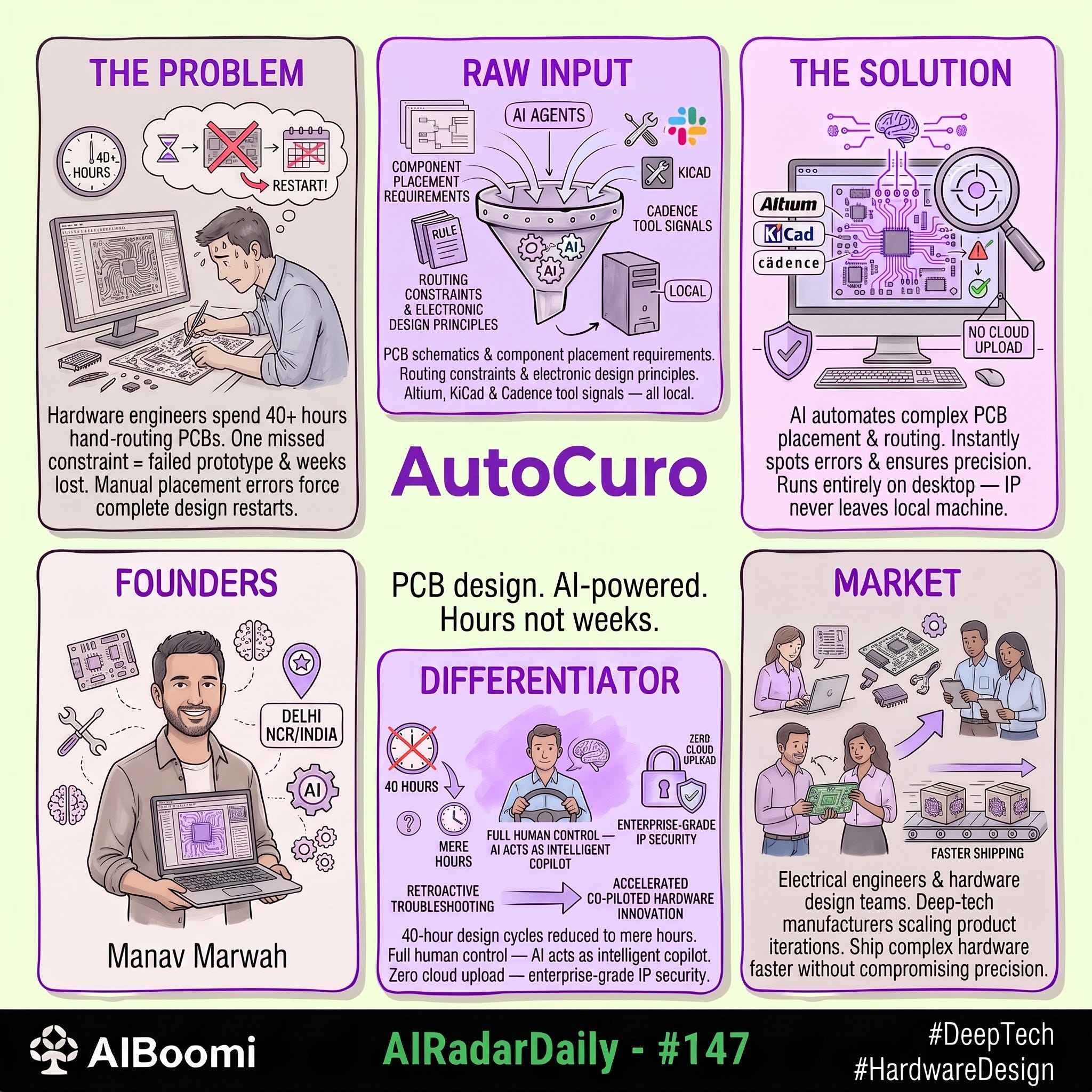
There is a quiet, exhausting reality at the heart of electronics innovation today. While the software layer of the world moves at the speed of thought, the actual hardware — the Printed Circuit Boards (PCBs) that power everything from autonomous vehicles to edge AI devices — remains trapped in an agonizingly slow manual process. Hardware engineers are forced into a grueling cycle, spending upwards of 40 hours per design meticulously hand-routing traces and manually placing hundreds of microscopic components on a board. One missed constraint or tiny placement error means a failed prototype, forcing teams to scrap their work and restart the weeks-long design cycle from scratch.
It takes builders with deep domain expertise to look at this bottleneck and solve it at the root. That is exactly what Manav Marwah is doing with AutoCuro.
Founded in 2024, the Delhi NCR-based team is building a deeply intelligent, automated PCB placement and routing platform that actually thinks like an experienced hardware engineer.
AutoCuro integrates directly into industry-standard tools like Altium Designer, KiCad, and Cadence. Instead of relying on rigid, legacy auto-routers that hardware engineers inherently distrust, it deploys proprietary AI algorithms that fundamentally understand electronic design principles. It intelligently automates complex component placement and routing, instantly spotting errors and ensuring precision. But crucially, it does this without ever compromising intellectual property — the platform runs entirely on the engineer’s desktop, ensuring that sensitive schematics and layout files never leave the local machine.
The true moat here is uncompromising design accuracy paired with enterprise-grade security. AutoCuro doesn’t ask hardware teams to surrender control or upload their proprietary designs to the cloud. It acts as an intelligent copilot, keeping full human control at the center while completely abstracting away the soul-crushing busywork of manual placement. By reducing 40-hour design cycles down to mere hours, it shifts the paradigm from retroactive troubleshooting to accelerated, co-piloted hardware innovation.
The market? Electrical engineers, hardware design teams, and deep-tech manufacturers who desperately need to scale their product iterations and ship complex hardware faster without compromising precision.
Seeing homegrown founders head-down, quietly architecting the heavy-duty infrastructure that brings intelligent automation to the very physical foundation of modern electronics, is profoundly inspiring. They are giving hardware engineers their velocity and their deep focus back.
Let’s celebrate the builders.
✍️ Jay Ingle
#DeepTech #HardwareDesign #ProductNation
"Software moves at the speed of thought, hardware stays trapped" is such a great way to frame it. Wild that we can spin up cloud infrastructure in seconds, but a missed trace on a PCB still means throwing away weeks of work.